SEO isn’t dying. Mediocrity is.
Every few years, someone announces the death of SEO. Loudly. Confidently. Usually with a headline designed to age badly. And then SEO does what it always does - it adapts and keeps working.
What is dying right now is not SEO itself, but low-effort content. Pages written just to exist. Articles created to fill gaps instead of answering real questions. Mediocre content that once survived on volume is quietly disappearing from search results.
This is not the end of SEO. It is a cleanup.
SEO has been declared dead before. It survived every time.
Mobile-first indexing was supposed to kill SEO. Page speed updates were supposed to kill SEO. Helpful content updates were supposed to kill SEO. Now AI and LLMs are supposedly delivering the final blow.
Yet SEO is still here because it is not a tactic. It is infrastructure. Search engines still need structured websites, clear signals, technical foundations and content they can understand.
What has changed is what gets rewarded. SEO today no longer works in isolation. It increasingly overlaps with GEO and LLM visibility. Being indexable is not enough. You need to be understandable.
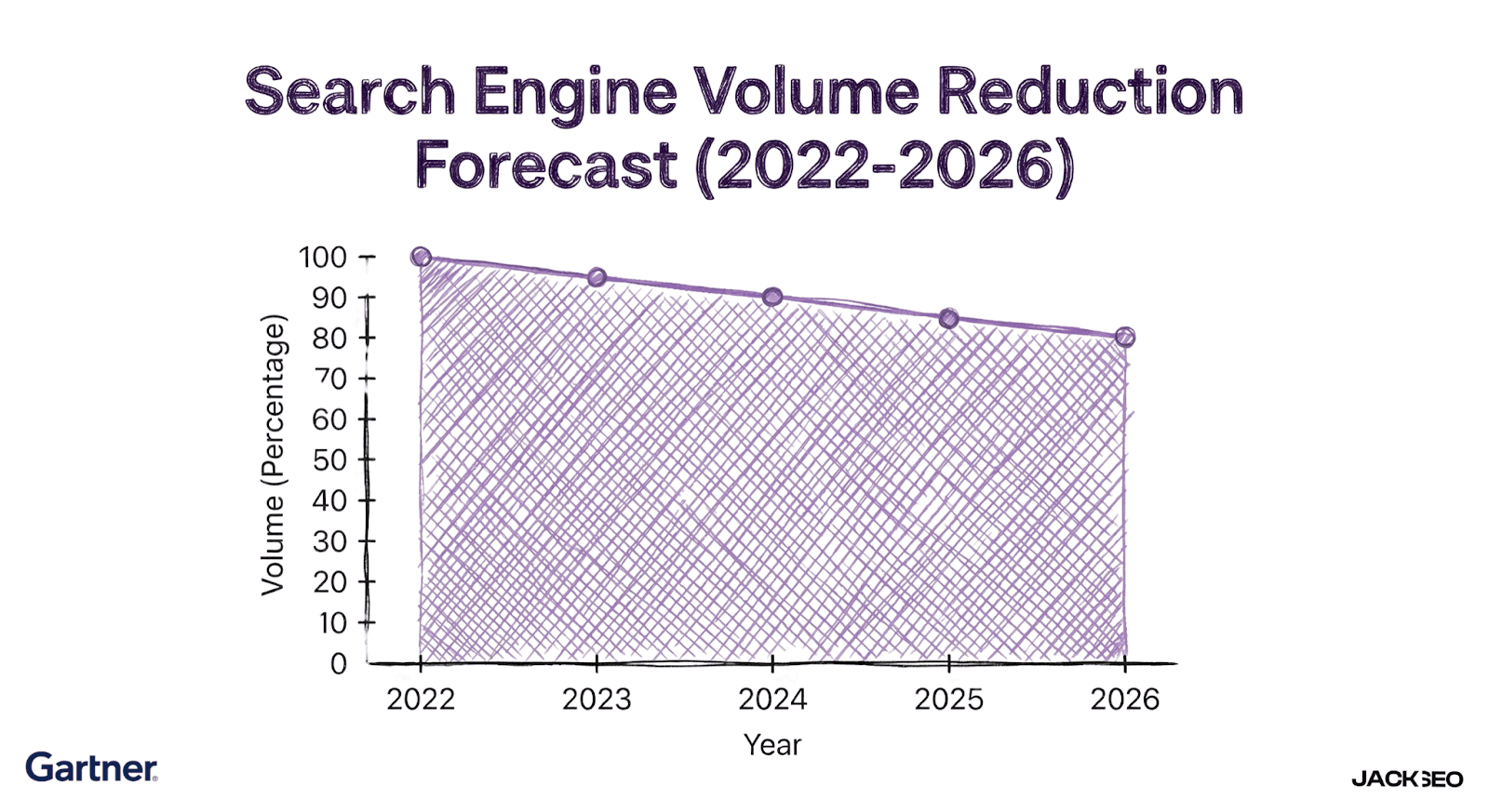
This shift is reflected in market forecasts like Gartner’s report “Predicts Search Engine Volume Will Drop 25% by 2026, Due to AI Chatbots and Other Virtual Agents.” Search volume is expected to decline not because people stop searching, but because more answers are delivered before a click ever happens.
Google is cleaning house and mediocre content is the first to go
Recent Google updates are not random. They are systematic. Spam-heavy sites, thin content and mass-produced articles are losing visibility, while pages that demonstrate real experience and expertise are gaining ground.
This is where E-E-A-T stops being an acronym and starts being a filter. Experience, expertise, author credibility and trust signals now matter more than keyword density or publishing frequency.
SEO is no longer a loophole-based game. It increasingly rewards content that could survive outside of search engines. Content written for people, not just crawlers.
Zero-click search proves why “good enough” is no longer enough
One of the clearest signals that mediocre SEO is no longer working is the rise of zero-click searches. More and more users get what they need without ever visiting a website. The answer appears directly in Google, or the search journey ends without a click at all.
According to SparkToro data based on DatOS, around 58–60% of Google searches in both the US and the EU now result in zero clicks. That means the majority of searches do not send traffic to any website, even if a page technically ranks on the first page.
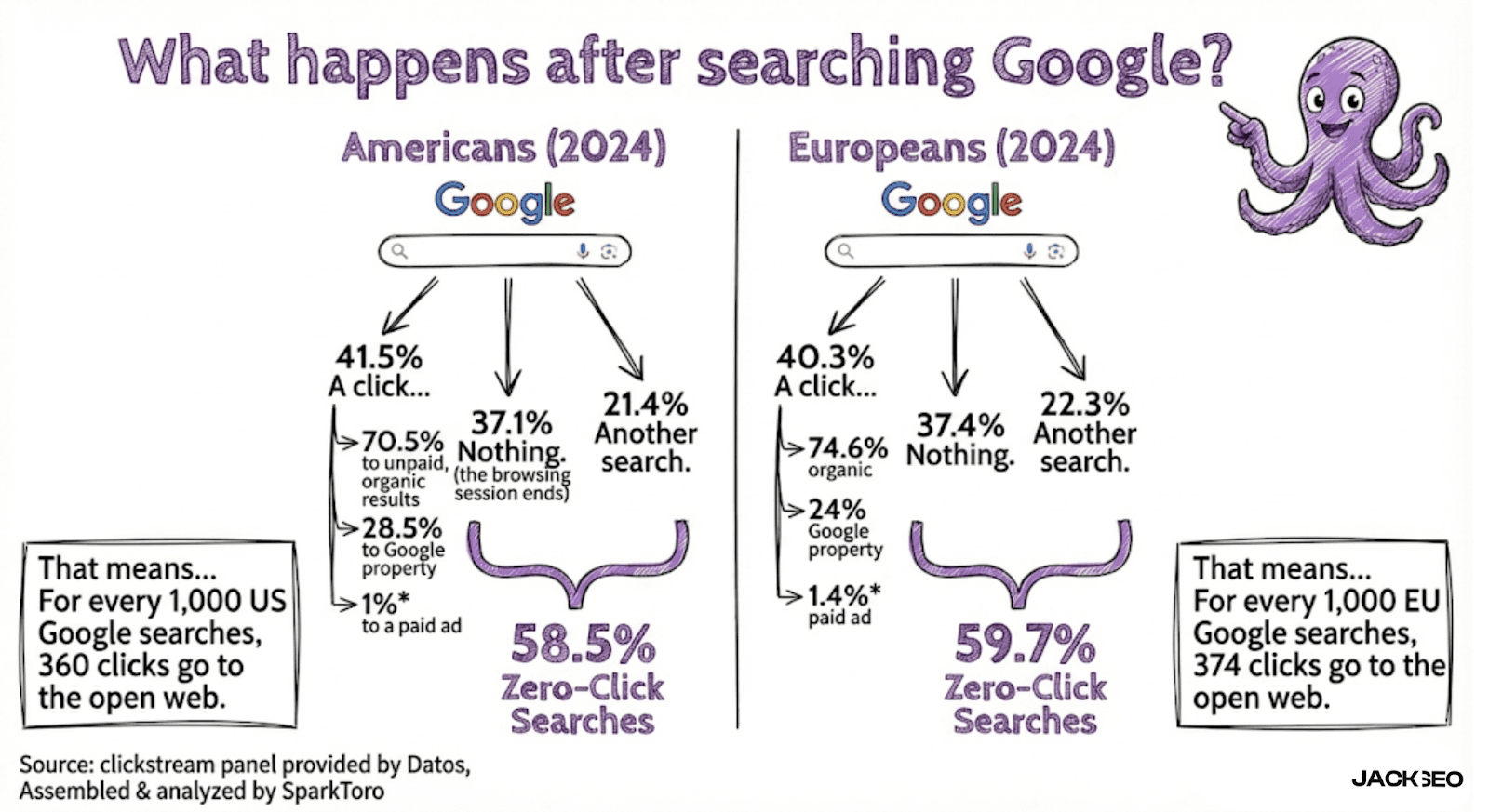
This changes the rules of the game. Ranking is no longer the same as influence. Being visible in search results does not automatically mean being part of the answer. If your content is not used, summarized or referenced, it quietly disappears from the decision-making process.
This is the mechanism most brands miss.
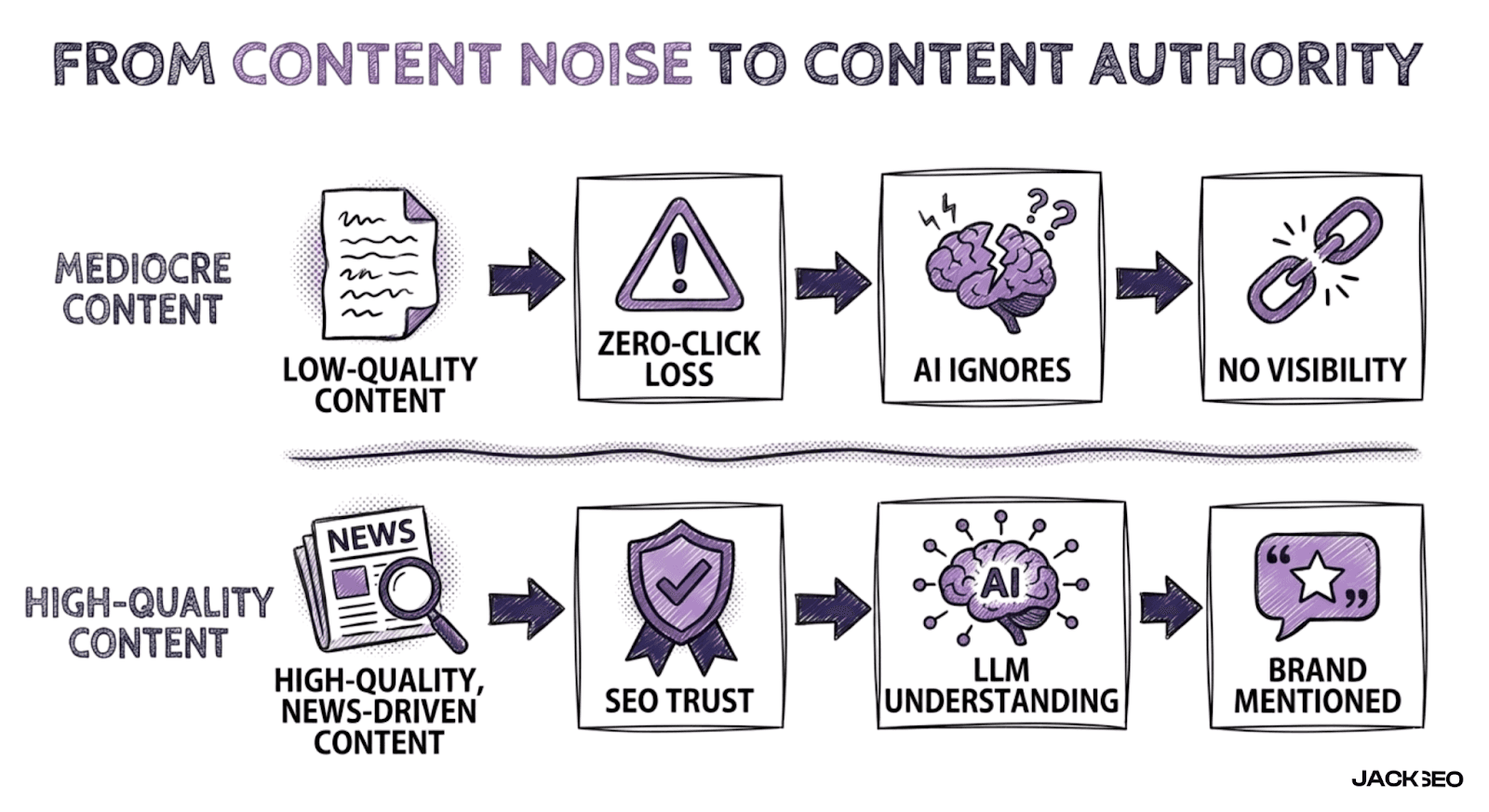
Low-quality, generic content leads to zero-click loss, then to AI ignoring the source entirely, and finally to no real visibility at all. On the other hand, high-quality, news-driven content builds SEO trust, helps LLMs understand the brand, and increases the chance of being mentioned when answers are generated.
This is why “good enough” content stopped being good enough. Not because SEO failed, but because the bar for usefulness moved higher.
AI answers simple questions. Your content must answer the important ones
Large language models are extremely good at handling simple queries. Definitions. Lists. Basic comparisons. This is not a threat - it is a signal.
AI systems compress information. They choose sources that are clear, consistent and authoritative. If your content says nothing new, AI has no reason to include you.
This is where SEO alone reaches its limit. GEO and LLM visibility step in by focusing on meaning, context and authority instead of repetition.
Think of it this way: SEO gets you indexed. GEO determines whether your ideas survive compression.
SEO and GEO are no longer separate disciplines
Modern search visibility sits at the intersection of classic SEO and generative engines. Search engines still crawl pages. LLMs still learn from structured, credible sources. But both now prioritize usefulness over volume.
This is why content strategies built only around keywords struggle. They optimize for ranking, but not for understanding. And understanding is what AI systems reward.
How JackSEO helps fight mediocrity at scale
This is exactly the gap JackSEO is designed to address. Instead of producing more content, it helps create better content - content grounded in real context, trends and expertise.
By combining SEO foundations with GEO-focused signals like newsjacking, narrative consistency and brand voice, JackSEO supports content that search engines can rank and LLMs want to reference.
News-driven, relevant content is naturally aligned with both systems. It earns attention in search and becomes material AI systems use when forming answers. That is how visibility compounds instead of decaying.
The real shift is not SEO vs AI. It is quality vs noise.
SEO is not dying. It is becoming more honest.
The era of content shortcuts is ending. What remains is content that has a point, a perspective and a reason to exist. SEO still matters. GEO and LLM visibility now complete the picture.
If your content is valuable, SEO will amplify it. If it is mediocre, no optimization trick will save it.